A cross-industry selection of research, strategy, and design sprint engagements with Fortune 500 companies and global tech platforms.
The Challenge
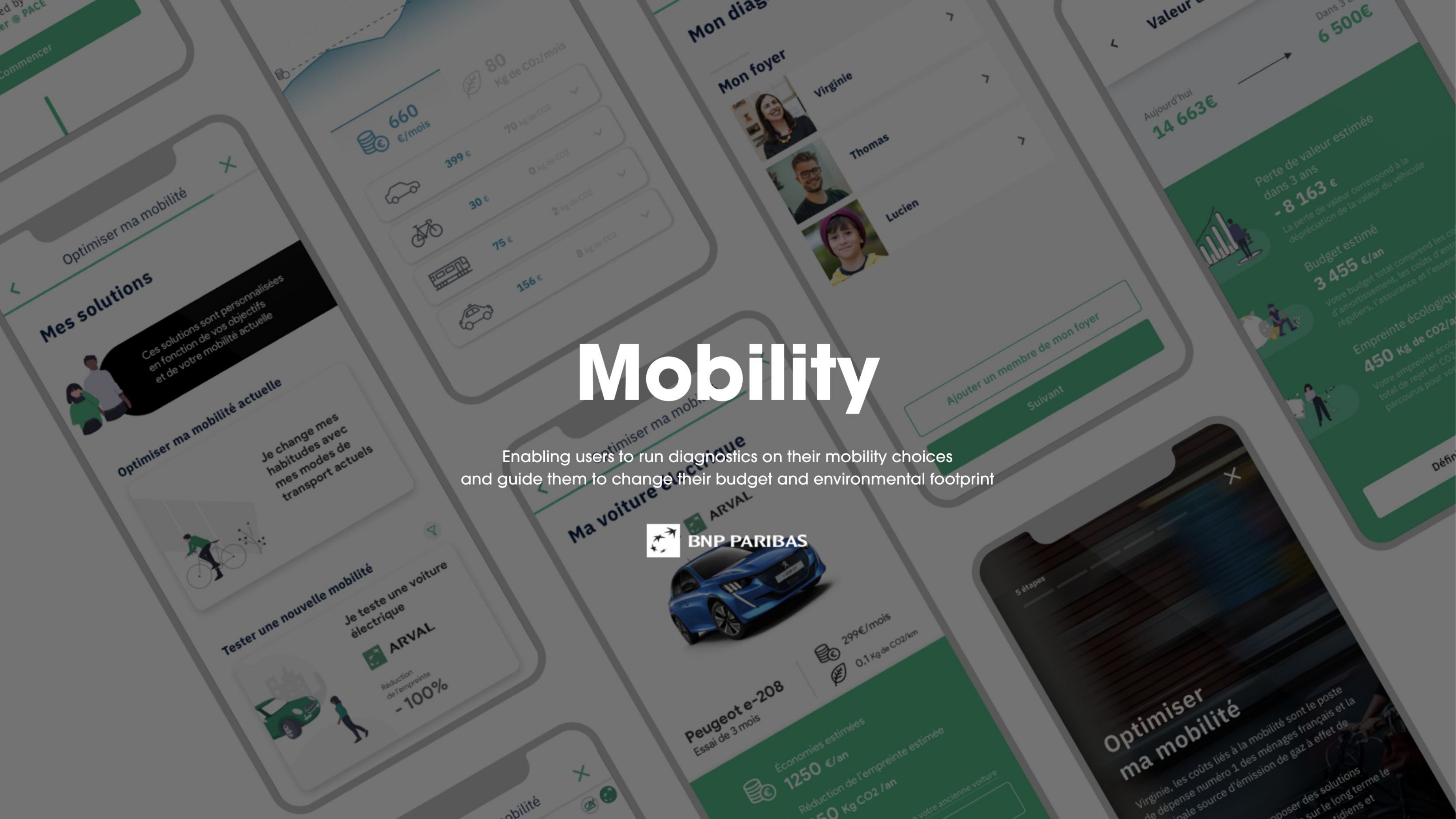
Users had limited visibility into the financial and environmental impact of their daily mobility choices - and no tools to understand what changes were actually feasible given their constraints. BNP Paribas and Arval saw an opportunity to enter the Mobility-as-a-Service market and needed research to validate the direction.
The Approach
Working with BVA Group, I led a multi-country qualitative research study to understand how people make mobility decisions - when, why, and how they consider changing. The insights directly fed a one-week design sprint to co-create and test a mobile concept, which was then iterated and embedded in BNP Paribas's daily banking environment.
Qualitative research (scope, recruitment, 60 interviews, analysis), design sprint facilitation, user testing, UX & UI design
Step 01
60 semi-directive interviews across 5 countries to map mobility decision-making: when, why, and what drives change.
Step 02
A detailed decision-making framework mapping triggers, blockers, and levers for mobility behavior change.
Step 03
1 week to co-create and user-test a mobility optimization concept with business stakeholders and end-users.
Step 04
Iterated prototype based on user feedback, then placed the concept within BNP Paribas's daily banking mobile app.
Segmented user profiles (The Car Addicts, The Hesitating, The Trapped) with behavioral triggers and mobility levers.
A decision-making framework detailing the full process by which users consider changing their transportation modes.
High-fidelity interactive prototypes for mobility diagnostics and goal-setting, tested with users and embedded in banking app.
Multiple business units acknowledged the value of research at project start, choosing to expand the scope of work.
The double diamond approach and iterative mindset were adopted by the business unit as standard practice.
Refined value proposition was tested, implemented in the daily banking app, and used for promotion in other markets.
Users' mobility needs and the business goal of utilizing internal assets aligned perfectly in the solution.
Business unit built an operational model including roles and responsibilities for the bank and potential partners.
Based on research, concept, and economic model, the bank identified and validated the business opportunity in multiple markets.
Organisation
BNP Paribas PACE (Paris), Arval, BVA Qualitative Factory
My Role
Qualitative research, design sprint facilitation, user testing, UX & UI design
Team Members
Innovation Managers, UX & UI Designers
The Challenge
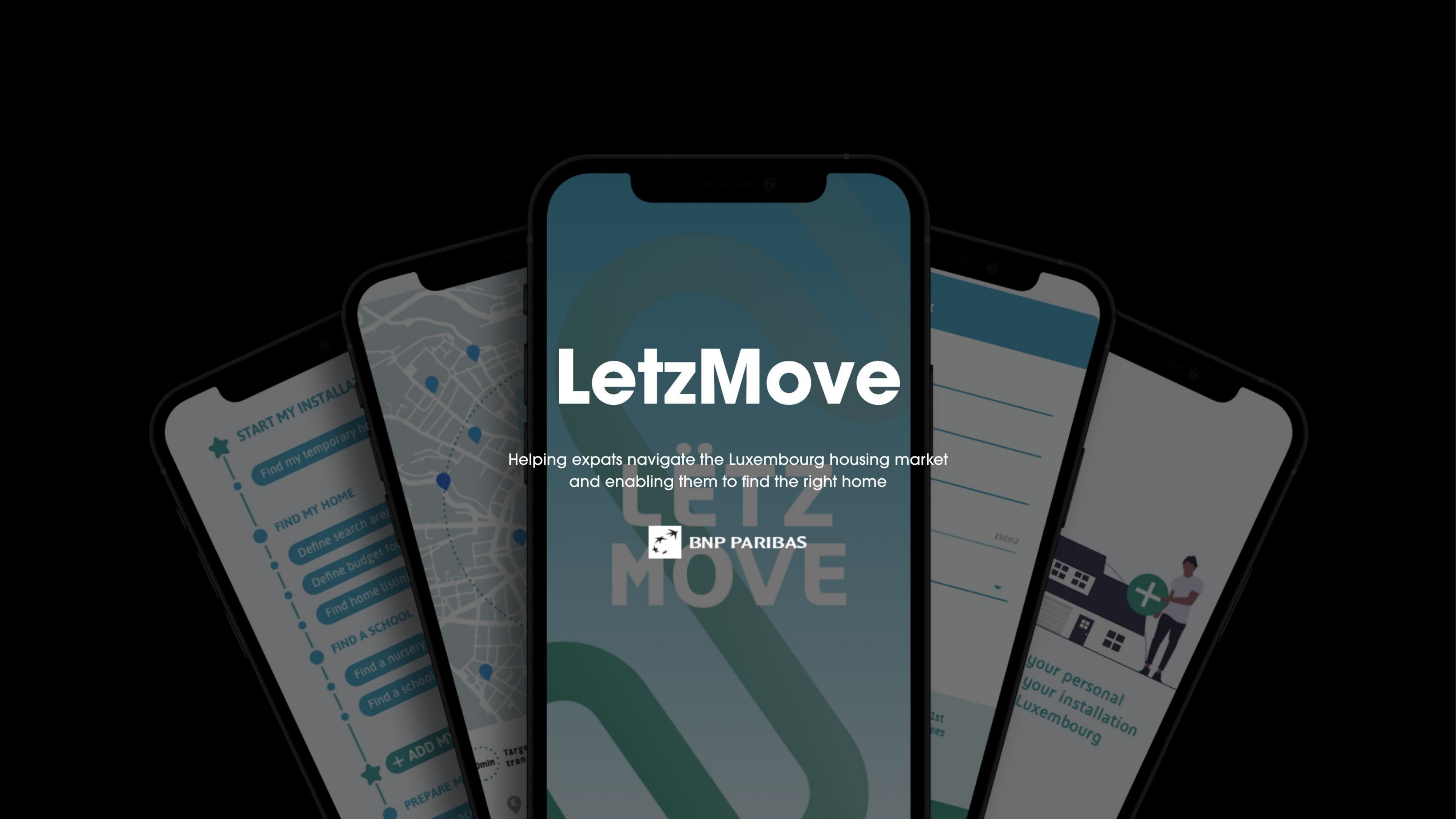
Luxembourg's housing market is notoriously tight - demand outstrips supply, timelines are brutal, and the complexity of prices, processes, and intermediaries forces people to make high-stakes decisions under pressure. BNP Paribas's Luxembourg branch wanted to create a service that would help expats navigate this experience while building a new client acquisition channel.
The Approach
I started by interviewing stakeholders to align on the business context, then conducted in-depth user interviews to map the full expat experience - from planning to settling in. A co-creation design sprint produced a mobile app concept, which was then tested through a landing page and prototype study to validate the value proposition before any build investment.
Qualitative research (scope, recruitment, interviews, analysis), design sprint facilitation, pitch, user testing, UX & UI design
Step 01
4 semi-structured interviews to outline the business context, expected outcomes, roles, and success criteria.
Step 02
16 semi-directive interviews uncovering expat pain points, preoccupations, and needs across the relocation journey.
Step 03
1 week to co-create and user-test a concept with business and users, defining next steps with stakeholders.
Step 04
2 landing pages + mobile prototype deployed to proof the product. 10 testing sessions to gather feedback and validate.
A prioritized map of expat needs - housing, admin, schooling, local services - across the full relocation timeline.
End-to-end service blueprint of the expat journey from announcement to settlement, with macro and micro steps and touchpoints.
High-fidelity prototype and two landing pages used to test the value proposition with 10 real users before development investment.
Research findings and concept testing confirmed a real market opportunity in the Luxembourg expat segment.
The business team acknowledged the value of user research - and even displayed the experience map in the office.
Double diamond and iterative design approach adopted by the business unit as standard for future projects.
Refined VP tested on a landing page and mobile prototype, allowing the business to promote the service to partners.
Expat needs for easy home-finding and the bank's goal of recruiting new clients coincided perfectly in the solution.
Business unit built a partnership model with defined roles and responsibilities for BGL and potential market partners.
Organisation
BNP Paribas PACE (Paris), BGL Innovation & New Business (Luxembourg)
My Role
Qualitative research, design sprint facilitation, pitch, user testing, UX & UI design
Team Members
Bank Director, Innovation Managers, UX & UI Designers
The Context
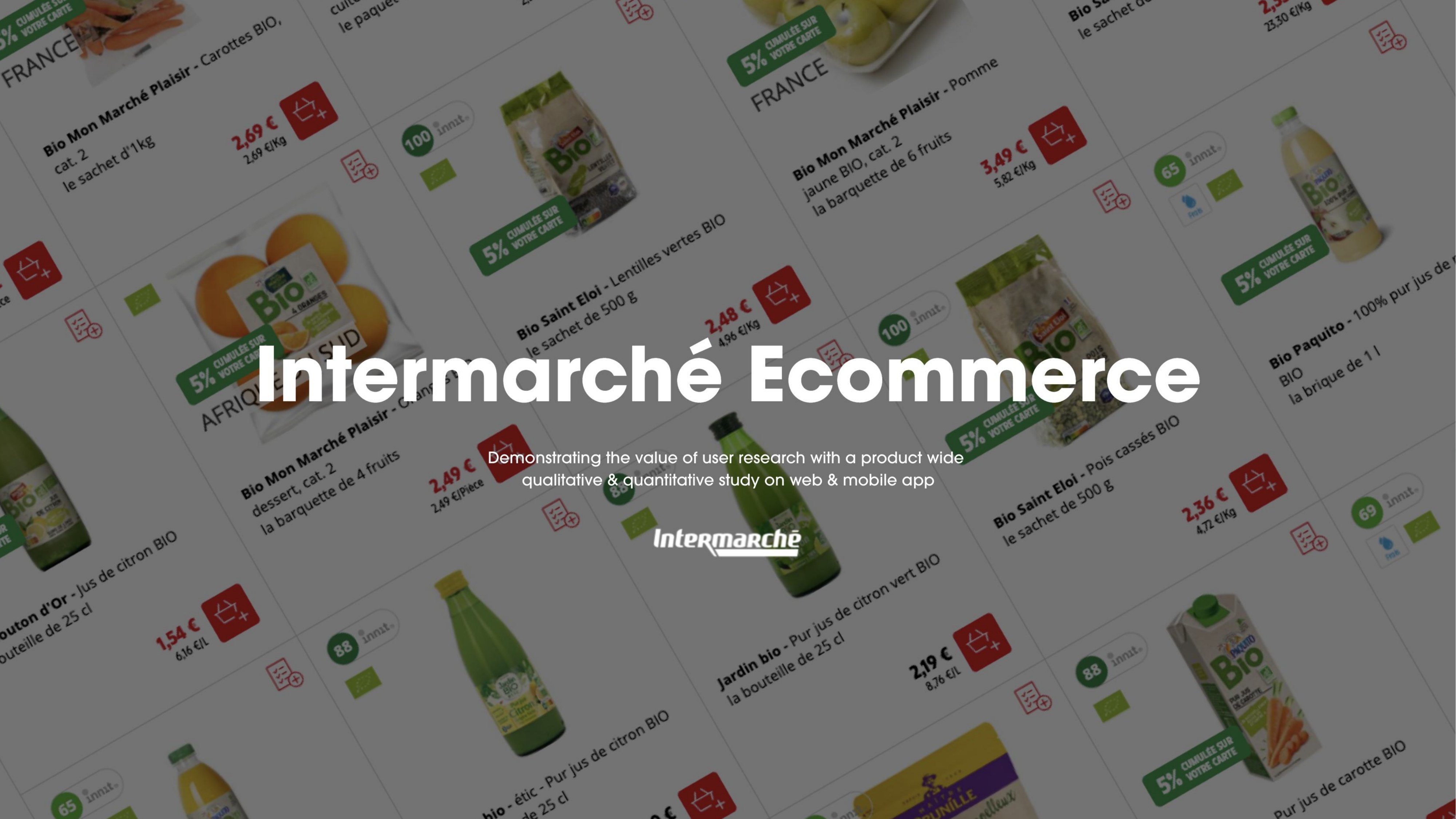
With online sales skyrocketing during the pandemic, Intermarché faced significant changes in purchasing behaviors across their ecommerce conversion funnel. Yet no explorative or evaluative research had ever been conducted at the organization. This was an opportunity to demonstrate the strategic value of research - and build a practice from scratch.
The Approach
I started by working with the UX Lead to outline a Research Ops strategy - defining what "good research" would look like at product scale. Then I ran a comprehensive mixed-methods study across the full product, combining user testing, interviews, surveys, and data analysis. Everything fed into a structured insight repository built on atomic research principles.
Qualitative & quantitative research (scope, recruitment, user testing, interviews, surveys, analysis, repository, restitution), workshop facilitation
Step 01
Internal workshops with Product Owners and UX team to align on research objectives, framework, and known pain points.
Step 02
30 sessions of mixed-method user testing and semi-directive interviews, plus 300+ customer feedbacks and internal surveys.
Step 03
300+ surveys, 4,000+ effort (CES) and satisfaction (CSAT) campaigns, and user data analysis across web and mobile.
Step 04
Using atomic research principles, findings were placed in an actionable database with user journey modeling and tagging.
A structured framework mapping terrain observations, research findings, and actionable design and business challenges by product area.
Comprehensive restitution of user needs, attentes (expectations), and pain points across the full e-commerce funnel - prospects and existing clients.
An atomic, tagged, searchable insight database modeling the user journey by macro and micro steps, enabling reuse across product squads.
Created the first-ever research practice at Intermarché, supporting e-commerce roadmap decisions across web and mobile.
Improved feature prioritization accuracy through research-informed backlog refinement, reducing post-launch rework.
Research approach, design principles, and methodology were adopted as standard practice by the broader product org.
Massive quantitative foundation complementing qualitative insights, giving the product team a robust, triangulated view of users.
Atomic repository enabled product teams to find and reuse research across sprints - shifting from one-off studies to cumulative knowledge.
Research findings directly shaped e-commerce product roadmap priorities across both web and mobile app surfaces.
Organisation
"Groupement les Mousquetaires" digital direction, UX Team, Scaled Agile Framework (SAFe)
My Role
Qual & quant research, scope, recruitment, user testing, interviews, surveys, analysis, repository, restitution, workshop facilitation
Team Members
Web & Mobile Product Owners, UX Lead, UI & UX Designers, Scrum Masters